


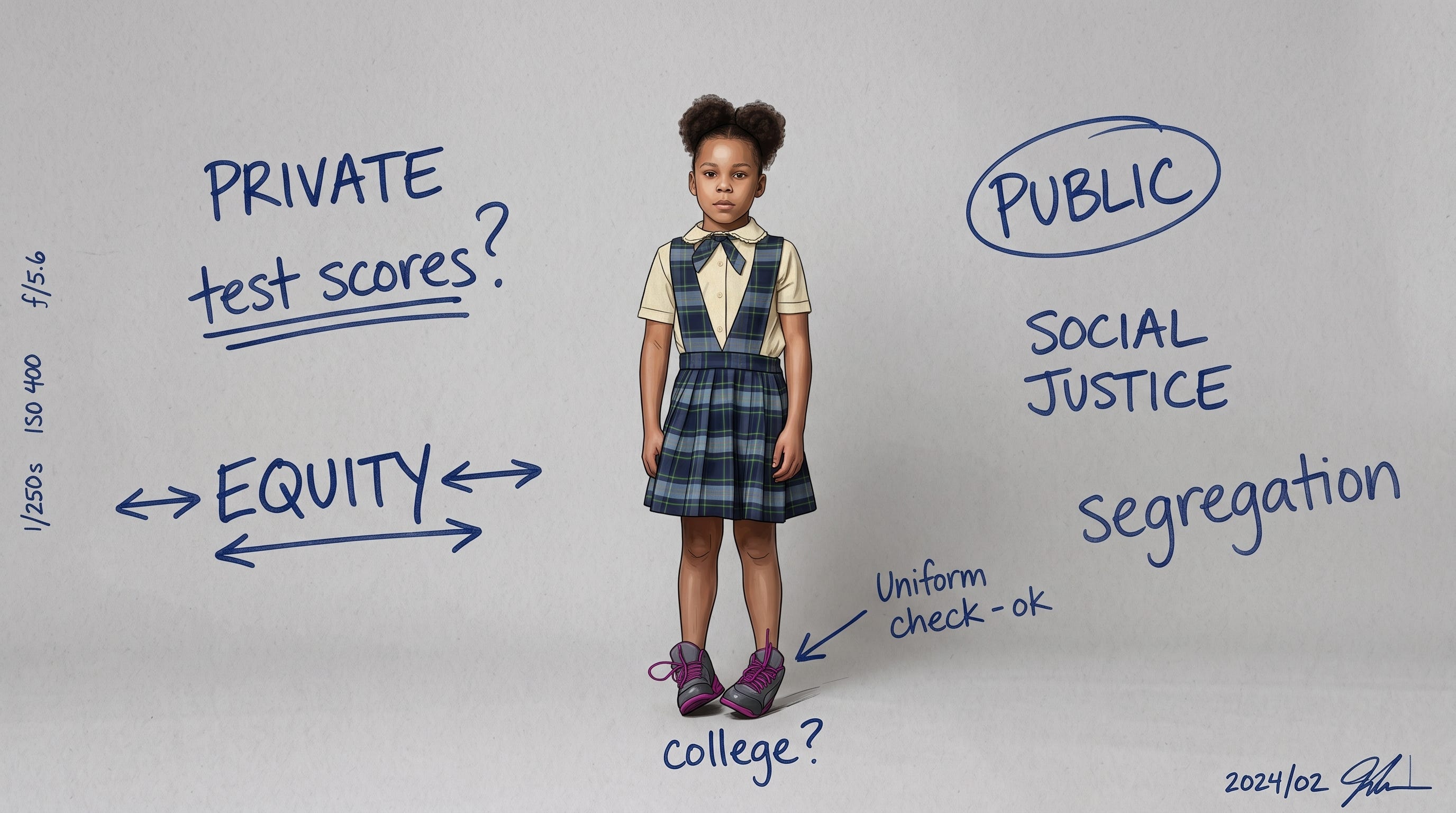
The first time I met Nikole Hannah-Jones, we sat on a panel at an education conference in Minneapolis, and I doubt she remembers it. The stage held much of the city’s thinking on Black education, including the leader of a successful Afrocentric charter school, a UNCF researcher, and Michelle Walker, who had worked in D.C. Public Schools. We talked about self-determination and about the Black educators who served as dual pilots for our children, teaching the academic core alongside the unwritten curriculum of surviving this country. When her turn came, Nikole said she was surprised by all the charter school love in the room.
I smiled, because she had wandered into one of the few rooms in America where that surprise made little sense. Progressive Minneapolis had a long history of liberal resistance to full integration, and when north side schools declined under white and middle-class flight, families answered with charters, magnets, and interdistrict options. Many of those charters were built by American Indian, African American, Latino, Somali, and Hmong communities to keep their languages and histories alive. Nikole had come to argue against the national brand of school choice, and her audience knew the homegrown version because their neighbors had built it.
Years later, at an NAACP hearing in Detroit, I told her the racial physics of this country made fully integrated public schools a naive dream. She answered, citing research from memory, that we would build successful integrated schools before we would build all-Black, high-poverty schools that work.
Her new essay in The New York Times Magazine, “In Fighting for Every Black Child, Did I Betray My Own?“, is the most honest thing I have read from the integration side of this argument. It revisits the decision she made public in a 2016 essay that put a kindergarten photo of her daughter, Najya, on the magazine’s cover, and this time Najya, now 16, cross-examines it. She tells her mother she never got the education she wanted. Nikole struggles, then does something rare for a public figure with a decade of speeches behind her. She apologizes, and in doing so she raises a question most of us stopped asking long ago, whether the children in our care are learning to their potential and how we would know if they weren’t.
Nikole and I have both written, many times, that Black students are less likely to have qualified teachers, rigorous coursework, current technology, and modern facilities. We have differed only on the remedy, and her essay convinces me we have been measuring the wrong thing. Any reform for Black children should be judged by the standard Black educators set long before Brown v. Board, which means rigorous teaching, honest assessment, and adults who answer to families, rather than by the racial makeup of the room. Najya’s schools failed that test in ways integration would not have fixed and accountability should have caught. Najya, who went looking for the truth about her own education and found she had been shorted, is the clearest reason to hold every school to it.
In 2019 I called integration a colossal failure, and more than once I wrote about Nikole nastily in haste. I approach both with more care today, because the evidence on what integrated schools do for civic life is stronger than I allowed, and because her essay models the kind of self-examination I owe my own work.
The heritage the integration story leaves out
The reason Nikole’s stubborn push for integration and her aversion to school choice grated on me is that they seem to discount Black agency. Integration orthodoxy has always rested on the claim that Black schools are inferior because they lack white children (plus the resources that come with them). History refutes that. Famed journalist Lerone Bennett Jr. noted that roughly one in twenty Black people could read and write at emancipation, and that within 35 years more than half could. That gain was won in makeshift schools, churches, and homes, by people who had been beaten for learning their letters, and it happened without a single white classmate.
We have too many examples of self-educating with high standards against huge odds to feel like beggars in policy circles.
At Washington’s M Street High School more than a century ago, Anna Julia Cooper insisted on a rigorous classical education for Black students and fought officials who wanted to steer them toward trades.
Across the segregated South, as Vanessa Siddle Walker has documented, Black educators shut out of white professional bodies built their own associations, journals, and statewide networks to share practice and press for resources, creating an organized profession accountable to Black parents and churches.
The Rosenwald schools, Piney Woods, the HBCUs, the Black independent school movement, and today’s best Black-led charter and district schools all belong to that line.
For most of our history, the young Black mind has been mothered by Black women educators. They answered the National Association of Colored Women’s call of “lifting as we climb” and took up Nannie Helen Burroughs’s motto, “We specialize in the wholly impossible,” on behalf of brilliant children in a world dulled by a monochromatic understanding of intelligence. From emancipation to Brown, they were the primary architects of our intellectual, social, and political development. Those who stayed in education after desegregation saw their authority diluted by white school boards and supervisors, and some had to ask white parents for permission to teach their children. But they never surrendered the work. Today they lead schools, districts, and support organizations, with more eyes on them and more politics against them.
I see a more generous picture now of how Nikole belongs to that line. She has long honored Ida B. Wells, who began as a Memphis schoolteacher, lost that job in 1891 after writing about the conditions of the city’s Black schools, and went on to educate a nation through her reporting. Nikole has the same gift for raising questions the powerful would rather not answer, and whatever our differences, we share the conviction that tradition asks of us, that Black children are brilliant and this country has never paid them what it owes.
Integration and choice matter only insofar as they answer the questions that tradition keeps asking. Does the school expect Black children to master hard material? Does it know what they have and have not learned? Do its adults answer to the families they serve? Does it treat Black children as heirs to an intellectual tradition rather than deficits to be managed? A reform that cannot answer yes has no claim on our children, whatever its politics.
The paradox she explains away
Nikole addresses the apparent contradiction of an integrationist sending her child to a poor, segregated school by arguing that the fight for integration was about equal resources, not about seating Black children beside white ones.
I concede the legal campaign was about resources. Others should concede that a theory of proximity to whiteness shaped it too, and that parts of the era’s educated Black leadership treated Black-run schools as damaged goods by definition. Derrick Bell, who litigated desegregation cases for the NAACP Legal Defense Fund before becoming one of the country’s most important legal scholars, named the problem from inside. In his 1976 Yale Law Journal article “Serving Two Masters,” he argued that civil rights lawyers had grown more loyal to the ideal of racially balanced schools than to Black clients who increasingly wanted better schools.
Black educators saw the danger. Siddle Walker’s history of the Georgia educator Horace Tate shows that many of them organized for desegregation while fighting over its terms, including who would keep their jobs, who would lead the new schools, and whether Black children’s dignity would survive the transfer. Their warnings were dismissed as self-interest, and the terms they feared are the terms we got. Tens of thousands of Black teachers lost their jobs across the South and border states after Brown, Black principals were demoted or dismissed at staggering rates, and the profession Siddle Walker describes was dissolved into systems that had no use for it. Families with the most means left Black schools first, taking with them the social capital Nikole later tried to supply at P.S. 307.
Thurgood Marshall predicted after the decision that school segregation could be gone within five years. It was one of the great miscalculations of the civil rights era, and it rested on an assumption W.E.B. Du Bois had rejected in 1935 when he wrote that “the Negro needs neither segregated schools nor mixed schools.” What Black children needed, he argued, was education, and I have not found a better sentence on the subject.
None of this makes integration worthless, and the either-or framing has kept thoughtful people from saying the obvious. Black-led schools have a record of excellence the integration story tends to erase, and integrated schools do real civic work, reducing prejudice and preparing children for life in a country that is not always united.
What actually failed Najya
Emily Paige, principal of Najya’s middle school, Unison, speaks sharply in the essay when she calls lowered expectations “racism under the guise of antiracism.” She seems to be begging for the truer story of Black education, the history where high expectations were a tradition long before anyone treated them as a burden on Black children.
The most useful part of the essay is its catalog of what went wrong, and almost none of it concerns a classroom’s racial makeup.
A lunchroom went unsupervised while adults watched children hit each other. A teacher missed so many days that students were parked in younger grades to work alone. Mandatory reading assessments apparently never happened. Math worksheets came home ungraded, so a girl who loved math thought she was excelling while getting most answers wrong. Parent emails went unanswered for weeks. In middle school, novice teachers led “Algebra for All” for students who had never mastered fractions, grades rewarded growth over mastery, and a no-homework policy left strong students without the habits high school would demand.
That list is a table of contents for the science of schooling, meaning curriculum, sequence, assessment, feedback, and the preparation and supervision of teachers. Nikole would answer, with good evidence, that none of it is random. Schools that concentrate poor Black children struggle to hire and keep experienced teachers, absorb more students with disabilities and trauma, lose their most organized parents first, and drift toward lowered expectations.
Najya found her footing in high school through a tutoring center that diagnosed her gaps and through two Black women teaching biology who opened their classroom to her. Nikole notes that those teachers had only a few students to catch up rather than a whole classroom. I read that as a question of staffing, time, and money, not demographics.
A school can be required to assess every reader, grade every assignment, put its strongest teachers in its hardest classrooms, and publish honest results, and it can be funded to do all of it. Integration would not have made her fourth-grade teacher grade the math, but a school built on accountability would have noticed that she didn’t.
For seventy years, families with the means to leave have outrun plans to reassign children, and a remedy that depends on their cooperation leaves Black children waiting on people who have already shown they won’t stay.
It’s telling that Najya earned A’s in algebra and then failed the state exam, which in her story was the one measure willing to tell her the truth. Much of the integration coalition has spent twenty years trying to weaken exactly that kind of measurement.
Her story is a school choice story
Nikole credits her success to a voluntary program that bused her from her segregated neighborhood in Waterloo, Iowa, to a well-resourced white school across town, and she calls herself a beneficiary of gains won by generations of Black parents.
A program that lets a limited number of Black children leave their assigned schools for better ones is integration, and it is also school choice. Najya’s screened high school was choice, and so was the tutoring her parents bought to fill the gaps her schools left. What we call these arrangements depends on who uses them. When some families leave an assigned school, we call it opportunity, but when a mother on the north side of Minneapolis does the same, opponents of choice call it draining the public system.
Paige blames “school-choice systems,” and Nikole calls New York’s academic screens a bargain to keep wealthier families from leaving. Reasonable people, me included, can argue about screens. But a district that sorts ten-year-olds by grades, interviews, and test scores is exercising its own power, not the family’s. The choice I have defended for twenty years is a family’s power to leave a failing school for one that works, with public dollars following the child and every option answering for results.
New York’s own data complicates Paige’s story. A 2026 study that followed a full city kindergarten cohort found that more than 40 percent of families opted out of their zoned schools, with Black and Hispanic families in the most segregated districts leaving at the highest rates. When the city published simple quality ratings, Opportunity Insights researchers found that Black and Hispanic families responded more strongly than white or Asian families, narrowing racial gaps in enrollment at strong schools, which should retire the assumption that low-income parents choose badly when given honest information.
The noble exit, and the cynical one
Here the integration argument does quiet damage, whatever its advocates intend. For many progressives, especially those whose careers depend on the traditional system, integration is a noble goal that costs nothing. It can be raised against charters, vouchers, non-union schools, testing, and accountability, letting a speaker sound like an heir of the movement while defending institutions that miseducate Black and brown children. New York shows how thin that commitment can be. A 2024 NYU Metro Center report found the city expanded gifted programs, let dozens of middle school programs restore academic screens, and never restored the diversity-planning money that ran out in 2020.
The right has its own version of a noble distraction covering an ugly inequity. For some conservatives, school choice is the entire sum of their commitment to civil rights, a cudgel against every call for funding equity, reparative action, or structural change. Choice without accountability is unserious.
I’ll never stop advocating for the greatest number of learning opportunities, but with conditions. I support every kind of option, public and private, district and charter, magnet and independent, as long as each is held to account for whether children learn. Options without accountability gave us Unison’s A’s in algebra. Accountability without options gave us P.S. 307, where a family with a New York Times byline couldn’t get a graded worksheet out of the building.
We are all Najya now
More than seventy years before Najya asked her mother whether she knew the school was bad, a 16-year-old named Barbara Johns led her classmates out of Moton High School in Farmville, Virginia, because their Black school was overcrowded and falling apart, and she asked for a decent school. The NAACP lawyers who took her case agreed to do so only if it sought integration instead, and her walkout became part of Brown. Two Black girls, three generations apart, asked the adults for an education, and both times the adults answered with a cause.
A seventh grader with a phone did the first honest audit of Najya’s schooling from the passenger seat of her mother’s car, after years of ungraded worksheets, skipped reading assessments, and A’s that meant nothing. She learned in an afternoon what the adults responsible for her had not told her in nine years. That is the question this whole argument turns on, whether our children are learning and how we would know, and the children are already asking it.
Nikole ends her essay by saying no one is absolved while we rescue our own children and leave others behind. I would add that there is no excuse either, when the most important fact about any school can be found by a seventh grader with a phone.
Najya went looking for the truth and found she had been shorted.
She asked the killer question that changed her mother’s thinking.
We should all be Najya now.
This hurts. I could have at least promised Ms. Hanna-Jones that in my math classroom she would have been taught explicitly, practice repeatedly, and assessed frequently. I won’t guarantee an “A”, but will guarantee honesty.
When my daughter brought home an essay with an A on it, I regraded it and gave her a C-. It’s not a lack of resources, it’s resource distribution. We need to put a spotlight on rigor. We need to educate parents on universal screening and make sure they understand what foundational skills are. We need to put teachers who can pass standardized tests in front of the neediest children. And we need to give them small class sizes so that they can manage deliberate practice and feedback.