

Somebody's Ghost Town
What I see when I photograph someone else’s nostalgia

They built these towns to last.
You can see it in the brickwork. In the carved dates above doorways that have outlived everyone who first walked through them. Litchfield, 1900. The year stamped high on the old facade like a promise. Someone believed the future would keep arriving here.
There was a time when Main Street carried the full weight of a community. The barber pole spinning all day. The theater marquee glowing on Friday nights. The American Legion hosting fish fries and funeral lunches. A church bell marking hours that felt steady and shared.
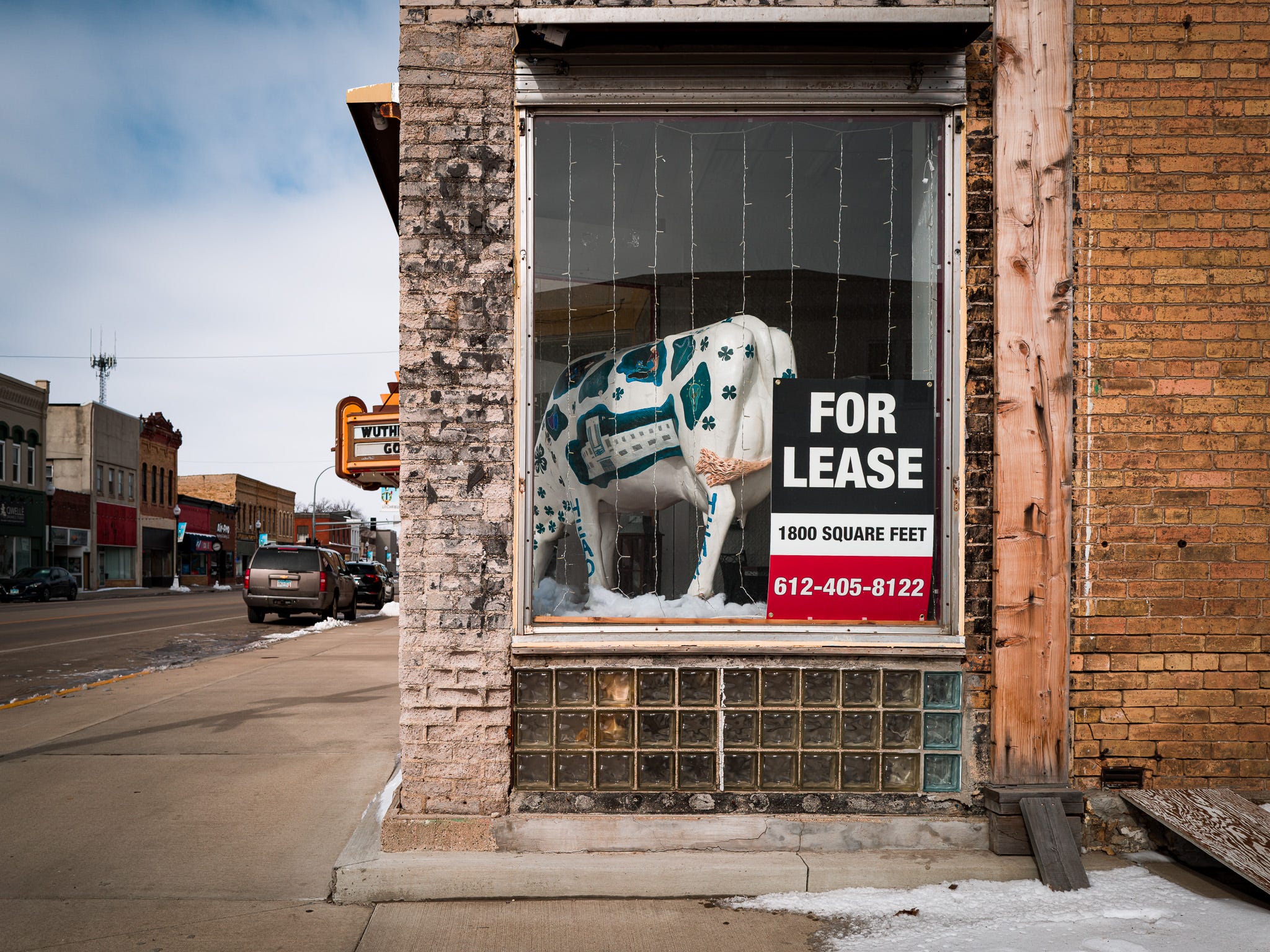
Now the windows hold different stories. A red door with hearts taped inside the glass, trying to summon romance back into the room. A storefront for lease, the square footage listed with quiet hope. A decorative cow in a dusty display window, painted with symbols of a town that once fed itself.
Snow settles into the cracks and stays there. A man walks his dog along a brick building that remembers more footsteps than it sees now.
Cars blur through, not stopping long enough to read the names painted above the awnings.
I drive hours to photograph these places. I stand on empty corners waiting for the right light on brick that hasn’t mattered to anyone in decades.
But I have to be honest about what I’m doing.
This isn’t my nostalgia. The Hollywood Theatre that once projected a purer version of America onto its screen also taught generations who was hero and who was threat. The simplicity everyone mourns included some very clear ideas about who deserved safety and who didn’t. Some of those golden eras did not hold space for everyone.


The buildings were not constructed as props, though. They were raised by people who expected their children to inherit them. Every closed storefront represents more than a failed business. It carries decades of labor, risk, pride. You can almost hear the cash register ringing, the door chime announcing another neighbor.
The American Legion sign stands firm while a red truck streaks past. The church remains upright, paint peeling but defiant. The post office anchors its block like an elder who refuses to move.
Modernity did not ask these towns for permission. Highways widened. Jobs centralized. Young people left for cities where ambition feels less confined. Main Street became a corridor instead of a destination.
And here’s where I get conflicted.
Just because this story was not mine does not mean it was not meaningful. Just because some versions of this past excluded people like me does not erase the dignity of those who found belonging here. There was an ideal embedded in these streets. A hope for a safe, predictable life. A belief that work would be enough and that neighbors would look after one another.
You can see the remnants of that belief in the careful upkeep of a brick facade. In the way the post office steps are still cleared of snow. In the quiet persistence of a barber shop sign that refuses to fade.
I understand the yearning for that version of America even as I know it required my absence to function. I can photograph the bones of it and feel something without pretending the flesh was ever mine to mourn.
Maybe that’s what I’m after in these frozen streets. Not the past itself but the shape of the longing. The architecture of a dream I wasn’t invited into but can still document.
These towns really were something. They are something still, even in their thinning light.
It’s not my story. But I see through my lens how it could be told.

[Shot with Leica / Litchfield, MN / winter 2026]