We All Transition
There comes a time to replace the old self with the true self

If you’ve been following my photo journey, you may have picked up on the redundancy I’ve been documenting. Discovering lessons in very small towns across Minnesota. Looking for photo-friendly old gas stations, dying Main Streets, the signs of religion and the flags of patriotism. It has created a homogeneous palette repeated endlessly with green grass, white churches, the occasional red barn. I’m fulfilled by that work. It matters to me to see beyond my cultural fences. But after weeks of that, I have needed something else.
Minneapolis interrupted the pattern.
Walking through the city is a honeypot for photography. The diversity is overwhelming. Somali families beside yuppies beside union workers beside punks. People in hijabs passing people in leather. Signs in windows and on lawns saying ICE is not welcome. Public schools and teachers are supported. Black lives still matter long after the corporate guilt fund depleted. It speaks loudly about who it is.
Minneapolis offers the opposite of Bowlus or Padua or Milaca. In those places I search for the story and the photo, but in the twin cities I can’t process all of the urban colors, the interesting subcultures moving separately, together, as if the city is a shared sandbox where difference isn’t a disease.
Even in the land of difference, there are still standouts, and Eliana came into my frame as one of them.
She was walking with a determined gate. Dressed boldly. Confident. Moving like she knew exactly where she was going and didn’t need permission to get there. I’m easily called to someone living their truth, stepping aside from convention not to agitate but to declare freedom from the mold society tries to fit us into.
I grew up a huge fan of people who broke established traditions, subverted techniques, challenged cultural dogmas. People who refused the safe and mannered version of themselves.
Bowie. Grace Jones. Of course, Prince.
I’m trying to get better about asking people for street portraits. It takes less gumption to wait for an opening, when someone sees my camera and jokingly says “shoot me,” or they initiate conversation about what I’m doing. That gives me permission. But the YouTube street photographers I follow constantly say we need more confidence. They say I will be surprised by how much more open people are than my fear allows me to believe. I’d rather be a spectator than an active documentarian, but that’s a limiting choice with no reward.
So I asked her.
“Would you be willing to do a portrait?”
She surprised me by her immediate response. “Hell yeah.” Energetic. Vibrant. Open.
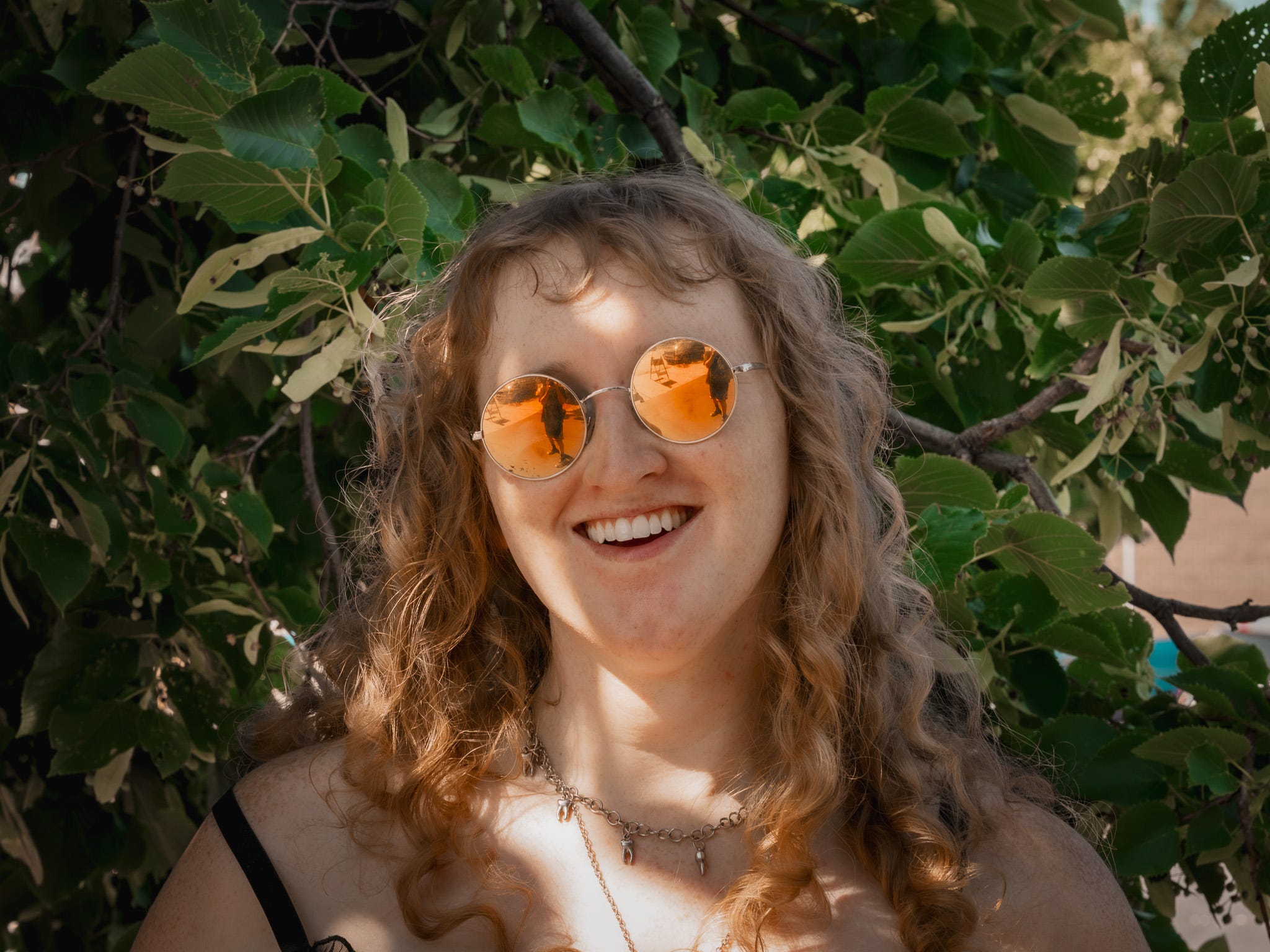
Her name was Eliana. She’d come from Wisconsin for Pride. She was dressed for the occasion, not hiding, not covering for the expectations of others.
We shot near a tree with equal parts sun and shade. I learned quickly what I dislike about street portraits that others do. It’s the posing, the artificial look. I want people to be people. To be their relaxed self. To see elements of who they are rather than replication of what a million other photos do.
I had to navigate territory I didn’t know. How do you position someone you don’t know enough about? What are the rules? How do I photograph the reality of transition without making it a spectacle?
And honestly, what about my own discomfort? My own baggage about manhood. The suspicious eyes of people walking by? The check on whether I’m being exploitative or not? Am I doing this right?
I'm in my own reckoning, my own move from the old me to the true me. So when I saw the pride in her stride, I recognized the liberation, but also the cost.
I tell myself I’m open-minded. An ally. Kinda conservative, sure, but kinda progressive too. But I’m not as evolved as I think I am. I’m humble about that because being smug about inclusive values is its own form of blindness. I can’t lie. I was awkward and uncomfortable. I was navigating something I didn’t fully understand.
Eliana made it easy by being herself. Joyful. Self-possessed. Unafraid.
What struck me most wasn’t her smile, though that was real. It was her commitment to self. Her surrender to being, as she is, to command her own space.
Some people moving from their old self to the new do so quietly. They blend in. They minimize the target on their back. I understand that strategy as survival.
Eliana had a different energy. She walked with her chin up, eyes forward, bare in places, moving past people in neighborhoods where many observers have brought religions to America that actively oppose her existence.
It made me think about the Bowies and Jones and Princes. About all the artistic agitators who cleared social paths that others eventually followed. What if we never had those risk-takers? Who would we be then?
Socially redundant, molded, and boring.
Perhaps the discomfort I felt during the shoot wasn’t just about not knowing the rules. It was recognizing that I actively participate in the systems that try to box her in. I’m not saying that proudly. I’m just being straight up about how my supposed progressive credentials don’t exempt me from the social order that creates laws and rules designed for my comfort and her exclusion. It’s a tough admission given my intense focus on how my racial identity is subject to marginalization. It’s not all that hard for victims and victimizers to trade places.
In some ways this meditation isn’t all that different than my journeys to small towns. What connects them is the same discipline. Stepping outside my comfort. Looking with empathy rather than judgment. Seeing through the eyes of people I might otherwise miss.
Minneapolis isn’t a small town, and Eliana isn’t MAGA, but I’m as alien to the liberal city as to the conservative town.
That said, my aperture is open, my lens focused, and my composition true to life.