
Tim Daly Sucks
I had to come back from mental slumber to address this shiznit


My friend Tim Daly is at it again, and, frankly, I’m quite tired of his insistence on writing things that make me think. His constant interruption of my logic-free summer is pestering.
His latest piece, “The Fall of the Class of 2023,” traces the kids who entered kindergarten in 2010, posted the highest fourth grade NAEP reading scores ever recorded in 2015, and then graduated high school in 2023 with some of the weakest SAT and ACT results in decades. Tim mined the student questionnaires that accompany NAEP and found four warning signs flashing in the data. Kids are reading less for fun, screens multiplying inside their classrooms, homework is shrinking, and test preparation was banished after the No Child Left Behind campaign ended. He weaves them into a unified theory about the erosion of sustained effort.
I imagine much of it is right. Tim is usually right. The reading-for-pleasure collapse is real, federally documented, and seen in all fifty states, which is genuinely strange and alarming. Habits don’t usually move like weather systems. The score trajectory is real too. And Tim is honest enough to say there’s no single dominant cause, which already puts him ahead of most education commentary. Education commentators can be so intent on selling a story or a remedy or a product that they skip past the humility of uncertainty into the profitability of authority. Not Mr. Daly.
My content has been a little light on education theses days. I’m fatigued by the anti-science of it all. I’ve been traveling, finding God and friends who are better positioned to be enemies, and plotting out the back nine of life.
So why am I writing this instead of enjoying my June?
Because I fear the distance between Tim’s evidence and Tim’s conclusions is wider than the essay lets on, and because education reform lives and dies on its ability to diagnose accurately. We have spent decades watching interventions built on confident diagnoses produce gains that evaporate, and the pattern of that evaporation tells us something the essay misses.
Four correlations in search of a mechanism
Tim’s four trends are survey self-reports that moved at the same time scores moved. That is worth knowing, but it is not the same as knowing they caused the decline, and it is definitely not the same as knowing that reversing them would reverse it.
My trouble with assembling a causal story from trends that happen to co-occur is that an enormous number of things changed in American life between 2010 and 2023, and almost any subset of them can be arranged into a narrative that feels complete. Tim picked four. I could pick four others, equally documented, equally correlated, and they would point toward entirely different remedies.
Take one I find genuinely interesting. Decades of research show that students who attend religious services regularly post better academic outcomes than peers who don’t. The most engaged students earn GPAs measurably higher than the unengaged, weekly attenders outperform never-attenders, and a report published this spring by BYU’s Wheatley Institute and Harvard’s Leadership Initiative for Faith and Education synthesized a wide body of findings connecting religious participation to grades, attendance, and aspirations. Meanwhile, the very years Tim studies coincide with one of the steepest stretches of America’s long exodus from routine worship. The problem is so accelerated that some sects of Christianity may go extinct.
See:
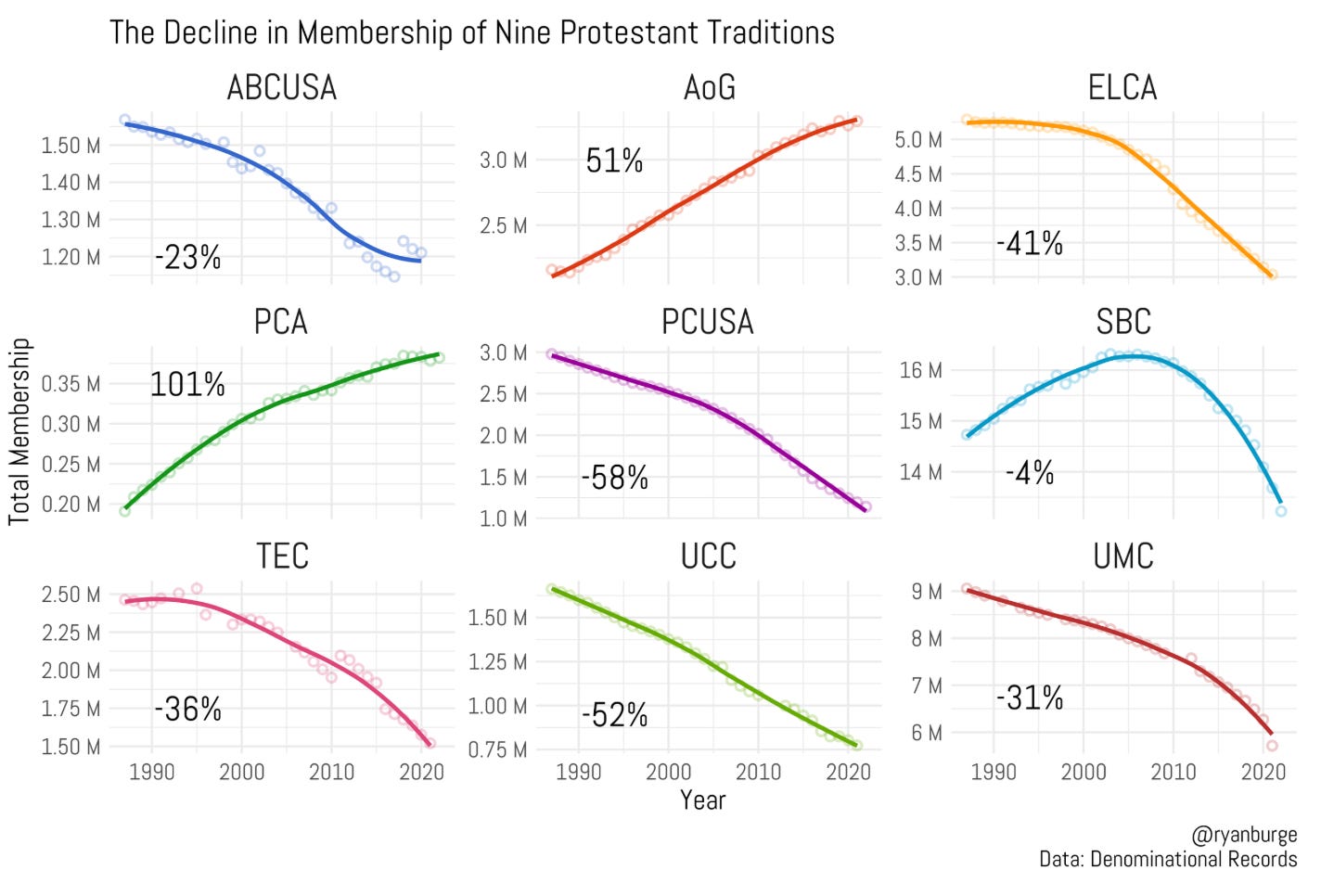
Am I claiming the emptying of pews caused the NAEP decline? Yes, if we’re talking as Christians, but no for our purposes here. For this, I’m doing the opposite. I’m showing how easy it is to find a documented correlation, attach a plausible mechanism (community, structure, adult mentorship, behavioral norms), and present it with the same confidence we do with associating homework minutes with student outcomes. The church data is real, the mechanism is plausible, and nobody, including me, has demonstrated causation. That should make us cautious about every other entry on the list, because the same epistemics apply to screens, homework, and test prep. American life shifted on a dozen axes at once during these kids’ childhoods, and the honest answer to “which shifts mattered” is that we don’t know yet.
The reading decline is bigger than the cohort
The strongest evidence in Tim’s piece actually argues against treating this as a story about one cohort or about schools at all. He says the screen shift “started at home,” and on this we agree, but the data suggests something even broader than parental modeling around 2010.
The American Time Use Survey shows the share of American adults who read for pleasure on a given day fell from 28 percent in 2004 to 16 percent in 2023, a steady relative decline of about three percent per year across two full decades. That slide began before the iPhone existed. It rolled through the NCLB era, the ESSA era, the pandemic, and every curriculum war in between without so much as a flinch. Children who stopped reading for fun were not deviating from the adult culture around them. They were converging with it. This matters for diagnosis.
If the decline in reading for pleasure is a downstream tributary of a forty-year cultural river, then remedies aimed at classroom practice, homework loads, or accountability dials are treating the symptom at the narrowest point of the system. They may still be worth doing. But we should expect them to behave like sandbags against that river, and we should stop being surprised when gains built in elementary school wash away by adolescence, when the cultural current is strongest.
The middle school problem nobody wants to study
I have a belly. I’m quite proud of it actually. But, I’m told, it is bad for my posture and overall health. A weak core is a vulnerability bigger than others.
Middle school is K-12’s belly, it’s weakest point, the place to kick if you want to take down the entire system.
Tim’s essay walks past the fade between fourth and eighth grade, which is not unique to this cohort. It is arguably the most consistent finding in modern education reform, and it suggests an institutional explanation sitting in plain sight.
Consider Mississippi, recipient of more uncritical praise than any state in recent memory. Its fourth grade reading gains since 2013 are laudable and nation-leading. But the picture compresses by eighth grade. Skeptics note that since 2005 the state gained fifteen points in fourth grade reading and only two in eighth, and that on the 2024 NAEP its fourth graders tied for eighth place nationally while its eighth graders tied for forty-second in reading. Defenders respond, fairly, that Mississippi’s eighth graders have improved over two decades while the nation declined, and that the gap with the national average at eighth grade is the smallest it has ever been. Both things can be true. The gains are real, and they shrink with altitude.
Florida offers us a starker version to consider. The state where school choice is more institutionalized than anywhere in America produced the nation’s second-highest fourth grade math scores in 2024, behind only Massachusetts, alongside eighth graders ranked in the bottom ten states in both reading and math, their lowest marks since the late 1990s. Whatever Florida is doing, it works in elementary school and stops working in middle school, and that is roughly the largest elementary-to-middle gap in the country.
Now hold those two states up against Tim’s cohort. Record fourth graders, faltering eighth graders. The shape is identical. Tim explains the shape with reading habits, devices, homework, and testing culture. But the same shape appears in states with wildly different policies, different demographics, and different reform theories. When the same failure recurs across that much variation, the common denominator deserves a hard look, and I’m interested in studying the common denominator being the institution of middle school itself.
We pour research, philanthropy, and political capital into early literacy and into high school redesign. The middle grades sit between them like a flyover state. The developmental period when kids most need belonging, challenge, and adult connection is the period when we hand them the largest schools, the most fragmented schedules, the least experienced teachers in many districts, and the thinnest research base. Maybe the Class of 2023 didn’t fall. Maybe it walked into the same structural hole every cohort walks into, at a moment when the cultural supports that once cushioned the landing had thinned out.
I’m not certain of that. I want to be clear that I’m offering it as a hypothesis deserving study, which is more epistemic caution than most unified theories extend. But it fits the evidence at least as well as the effort story, and it points toward very different remedies.
Beware diagnoses that flatter the remedy
And remedies are where my guard goes up, because Tim’s four causes map suspiciously well onto the familiar prescriptions of more homework, fewer devices, more accountability, and more testing focus. Each cause arrives pre-paired with a policy its author was inclined toward anyway. That doesn’t make the causes wrong. It makes them convenient, and convenience is exactly what a careful diagnostician should distrust.
On homework, as an example, I’ve watched multiple kids come home with assignments that were less about extending learning than about outsourcing half the teacher’s job to my kitchen table, crowding out recreation, social development, church, and family time that build children in ways no worksheet does. The research here across dozens of studies find homework helps when it is well designed, hurts when it is excessive, and matters far more in quality than quantity. The fact that eighth graders report less homework could signal lowered expectations. It could also signal districts responding, imperfectly, to legitimate evidence and legitimate equity concerns about unequal home environments. “Assign more” is not a diagnosis. It is nostalgia wearing a lab coat.
The stakes of getting diagnosis right
I titled this missive “Tim Daley Sucks” as clickbait, not because Tim actually sucks. He’s the last of education writers I read. I don’t trust all of the “entrepreneurs” who must overstate and misdiagnose any portion of education they can profit from fixing. Tim comes with science. The warning signs he highlights are the right ones for educational progress. The fact that we missed them in real time should haunt the people paid to watch these dashboards.
But the history of education reform is an America-sized graveyard of confident diagnoses, over-confident prescriptions, and chronic disavowal of interventionist failures. We diagnosed teacher quality and built evaluation systems that changed little. We diagnosed standards and built Common Core. We diagnosed school governance and built portfolios of choice. Each diagnosis contained truth. Each remedy underperformed because the diagnosis was partial, and the parts left out, the cultural currents, the middle grades, the texture of family and community life, kept doing their quiet work underneath.
The Class of 2023 should get a careful look. But, before we prescribe, I want a real differential diagnosis, serious study of the middle grades as an institution, honest accounting of cultural trends that schools ride rather than steer, and the discipline to say “we don’t know yet” out loud. Tim has given us a strong opening argument. It should be treated as the beginning of the inquiry, not the verdict.
Now if you’ll excuse me, I have a logic-free summer to salvage, and a friend whose next piece I am already dreading.